
Introduction
The Design-Build Process, reshapes how the artificial turf industry plans and delivers projects. This approach unites design and construction under one coordinated team. As a result, companies accelerate production, improve communication, and deliver higher-quality artificial grass systems. In addition, this method reduces delays and eliminates confusion between separate contractors.
Understanding the Design-Build Process
The Design-Build Process assigns one team to handle both design and construction tasks. In artificial turf production, the team designs the turf system, selects materials, manages manufacturing, and installs the final product.
This integrated structure simplifies decision-making. Moreover, it strengthens accountability because one team controls the entire workflow from concept to completion.
Planning and Design Phase
The process begins with a detailed planning stage. The project team first analyzes client needs, such as sports use, landscaping purposes, or commercial applications. The team also studies environmental conditions, including weather exposure and ground type.
Next, designers define key turf specifications. They select fiber height, fiber density, and backing strength. They also choose materials such as polyethylene (PE) or polypropylene (PP). In addition, they design drainage systems to ensure water flows efficiently through the surface.
Because the same team will manage construction, designers create practical and buildable solutions instead of abstract concepts. This alignment improves performance and reduces redesign risks.
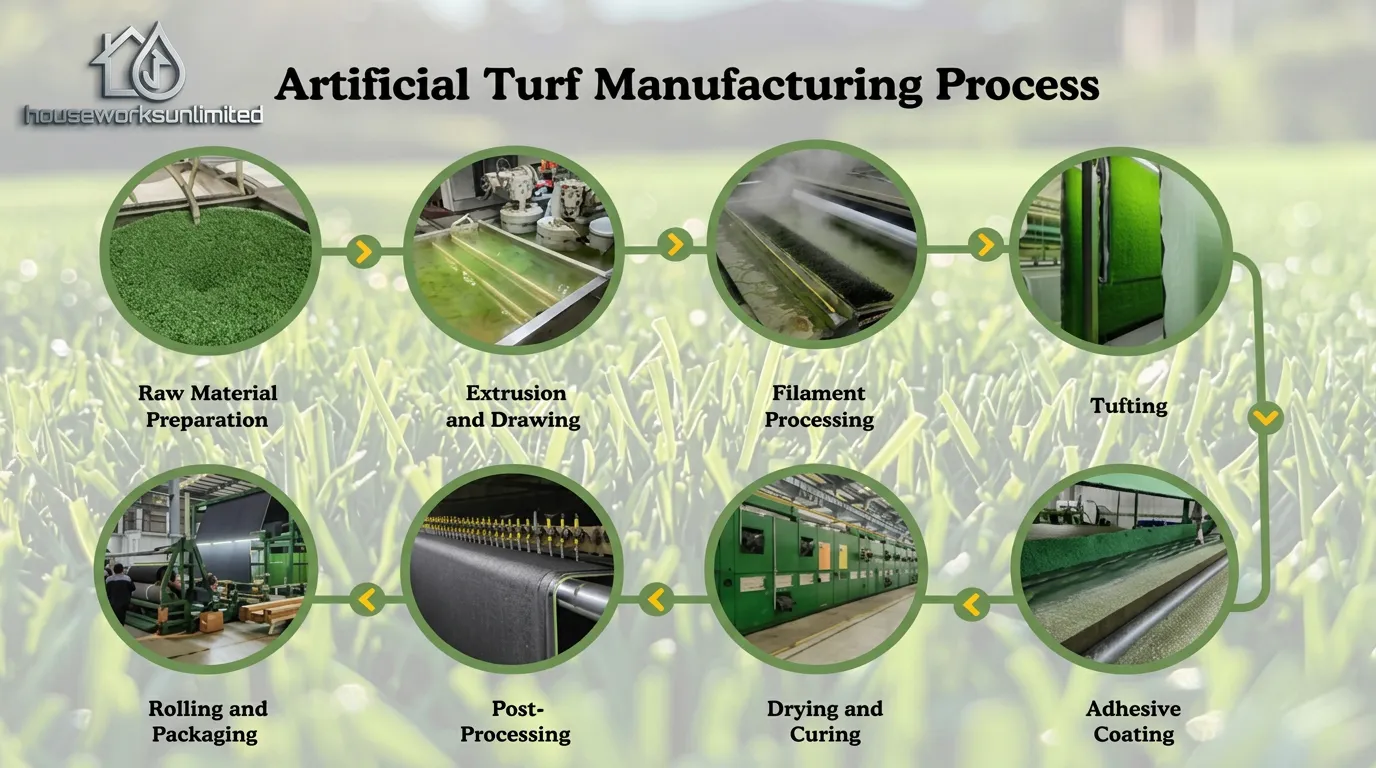
Artificial Turf Manufacturing Process
After design approval, production begins. Manufacturers process raw materials like PE and PP into synthetic fibers. They shape these fibers using high-temperature extrusion systems.
Then, machines stitch the fibers into a strong backing layer. This step requires precision because fiber density affects durability and playability. The production team monitors quality at every stage to maintain consistency.
Next, manufacturers apply a latex coating to lock fibers into place. This layer strengthens the turf structure and improves resistance against heavy use and weather changes. As a result, the artificial turf achieves long-term durability and stable performance.
Installation and On-Site Execution
Once production finishes, the installation team prepares the site. They level the ground and build a stable base layer using crushed stone or similar materials.
After that, the team rolls out artificial turf sheets across the surface. They align each section carefully to avoid gaps or overlaps. Then, they join seams using industrial adhesive or heat-bonding techniques.
Finally, the team adds infill materials such as silica sand or rubber granules. These materials improve shock absorption, stability, and player safety.
Because the same Design-Build team manages every stage, installation moves faster and follows the original design without deviation.
Key Benefits of the Design-Build Approach
The Design-Build Process offers strong advantages in artificial turf production. First, it shortens project timelines because one team manages all phases. Second, it reduces costs because the project avoids miscommunication and redesign work.
In addition, this approach improves quality control. The team monitors each stage closely, from design to installation. Therefore, the final turf system performs better and lasts longer.
Conclusion
The Design-Build Process transforms artificial turf production into a streamlined and efficient system. It connects design, manufacturing, and installation under one clear workflow. As a result, companies deliver faster projects, stronger products, and better customer satisfaction. This modern approach continues to set a new standard in the artificial turf industry.

Leave a Reply